Data Engineering
  Data Strategy + Governance
  Data Migrations
  Concierge + Support
  Artificial Intelligence
  Training + Enablement
  Data Analytics + Insights
  Financial Services
  Communications, Media + Entertainment
  Healthcare + Life Sciences
  Technology + Digital Natives
  Manufacturing + Automotive
  Public Sector
  Retail + Consumer Goods
  Race to the Lakehouse
  AI + Data Maturity Assessment
  Unity Catalog
  Rapid GenAI
  Modern Data Connectivity
  Gatehouse Security
  Health Check
  Sample Use Case Library
  Blog
Blog  Events
  About Us
  Careers
  Founding Team

Every enterprise running a modern data platform is managing two separate database systems. One handles real-time transactions. The other handles analytics. Both are necessary. Both are expensive. And in most architectures, the pipeline connecting them is the most fragile thing in the entire stack.
Databricks just made that pipeline optional.
OLTP and OLAP: Why Both Matter
Before advocating for Lakebase, it’s important to clarify the specific problem it addresses – since the OLTP versus OLAP distinction is fundamental and frequently misunderstood outside engineering teams.
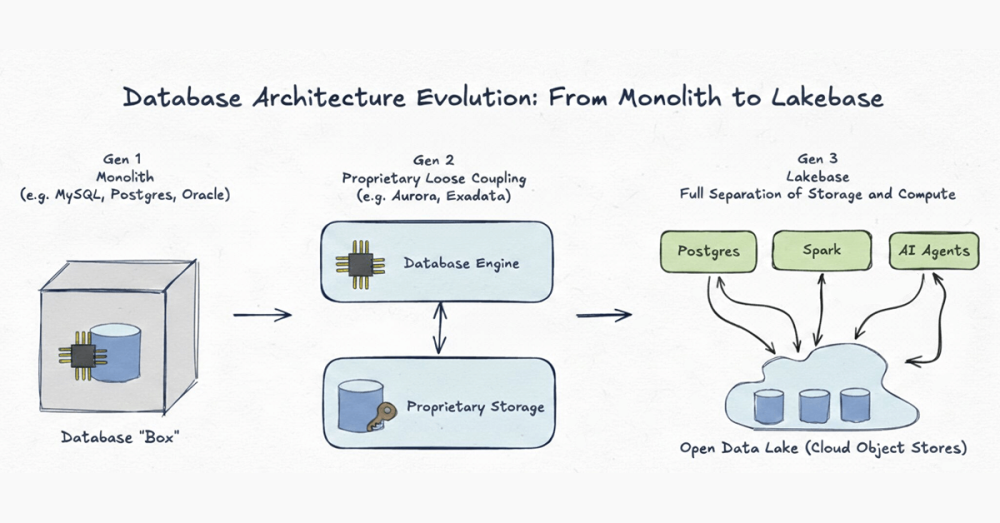
Source: https://www.databricks.com/blog/what-is-a-lakebase
OLTP (Online Transaction Processing) is the database layer that powers your applications. Every time a customer places an order, updates their profile, or submits a form, that write hits an OLTP system. These databases are optimized for high-frequency, low-latency read and write operations on individual rows. Speed and consistency are everything. PostgreSQL is the most widely adopted OLTP engine in the world today, and for good reason – it is open source, battle-tested, and has a rich ecosystem of tools and frameworks.
OLAP (Online Analytical Processing) is the database layer that powers your reporting, dashboards, and AI. These systems are designed to scan large volumes of data, aggregate across millions of rows, and answer complex business questions. The Databricks Lakehouse, with Databricks SQL as the query engine, operates here. It is not designed for individual row writes – it is designed for scale, and it excels at it.
Both are essential. A hospital cannot run on analytics alone – it needs a transactional system to track patient records in real time. A retailer cannot optimize inventory with a single-row lookup – it needs analytical systems to surface trends across millions of transactions. The challenge has never been which to use. The challenge has always been how to bridge the gap between them.
For decades, OLTP and OLAP have lived in separate systems, connected by ETL pipelines that move data from the operational layer into the analytical layer on a schedule. In practice, this means your analytics are always behind. Your dashboards reflect what happened hours ago, not what is happening now. Your AI models are trained on data that has already gone stale by the time they serve a prediction.
Databricks Lakebase: Closing the Gap
Lakebase is Databricks’ answer to this problem. It is a fully managed, serverless PostgreSQL OLTP database built natively into the Databricks Data Intelligence Platform. It reached General Availability in February 2026.
The key word in that description is natively. Lakebase is not a third-party database bolted onto the Lakehouse through a connector. It is built on technology from Neon – a serverless Postgres company acquired by Databricks – and it stores data in Databricks-managed storage, which means operational data and analytical data can coexist on the same governed foundation without a pipeline between them.
For organizations building critical business applications, three capabilities stand out:
- Near-zero latency: Lakebase delivers sub-10ms response times and supports over 10,000 queries per second. This is the performance profile that customer-facing applications require – not the minutes-to-hours latency of a scheduled ETL job.
- Automatic sync with Delta tables: Lakebase provides native sync between its Postgres tables and Delta tables in the Lakehouse. This means operational data written by an application becomes immediately available for analytics, AI model serving, and dashboards – without a custom pipeline.
- Serverless autoscaling: Lakebase scales compute dynamically based on workload demand and drops to zero when idle. There is no pre-provisioning for peak load, no manual cluster sizing, and no cost incurred when the system is not in use.
IMPORTANT: Lakebase is currently Generally Available on AWS. Azure is in Public Preview, with GCP support planned for later in 2026. Evaluate availability against your cloud footprint before committing to a migration timeline.
Where This Fits in the Broader Databricks Platform
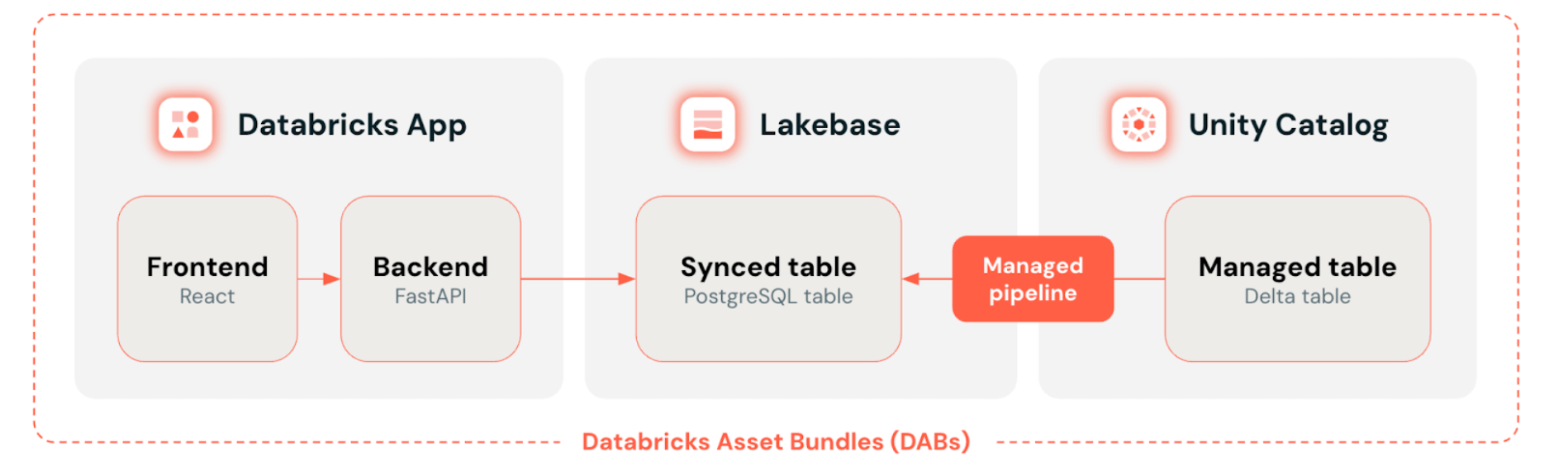
Source: https://www.databricks.com/blog/how-build-production-ready-data-and-ai-apps-databricks-apps-and-lakebase
Lakebase does not exist in isolation. Its value is multiplied by how tightly it integrates with the rest of the Databricks Data Intelligence Platform – the same platform discussed in previous articles on Data Modeling and Unity Catalog Federation.
- Unity Catalog governs Lakebase databases the same way it governs your Delta tables, ML models, and dashboards. A single access control model across your entire data estate – operational and analytical – eliminates the need to reconcile permissions between two systems.
- Databricks Apps allows you to build and deploy customer-facing or internal applications directly on the platform, with Lakebase as the transactional backend. The application, the database, and the analytics all live under the same roof.
- Databricks SQL and the broader Lakehouse remain the analytical layer. Lakebase does not replace them – it completes them. OLTP writes go into Lakebase. Analytical queries run against Delta. The sync between them happens automatically. The result is a unified platform where a single transaction can inform a real-time dashboard, trigger a model inference, and update a business application – all without leaving the Databricks ecosystem.
This is what Databricks means when it describes the shift from a system of record to a system of action. The data does not just sit there waiting to be analyzed. It drives decisions the moment it arrives.
Final Words of Advice
The boundary between OLTP and OLAP has been an accepted fixed cost in enterprise data architecture for many years, leading most organizations to accept it without question. Lakebase, however, directly challenges this long-held assumption.
My opinion: for organizations already on Databricks, this is not a product to evaluate casually. It is a strategic opportunity to collapse two separate stacks into one – and to finally deliver the near-real-time data that critical business applications have always needed but rarely had.
The question is not whether your business needs operational and analytical data to work together. It does. The question is how much longer are you willing to pay for the architecture that keeps them apart?
Stop paying the “hidden tax” of siloed data: contact Entrada today to discuss how Lakebase can unify your operational and analytical systems for real-time action.